

How Each Generation Views the Ideal Nose: What the Latest Study Reveals
When it comes to facial aesthetics, the nose plays a central role in defining harmony and balance. A recent study titled Current Trends in Ideal Nasal Aesthetics explored how different generations perceive the “ideal” nasal profile — and the results may surprise you.
The study focused on two specific features of the nasal profile: the radix height and the nasolabial angle (NLA). Here’s what it uncovered:
🔹 Radix Height: The Rise of the Augmented Profile
The radix is the point where the forehead transitions into the nose — essentially, the nasal root. Researchers found that younger generations (Gen Z and Millennials) prefer a higher, more augmented radix, creating the appearance of a longer nose. In contrast, Gen X participants leaned towards a slightly lower, more traditional nasal root height.
This shift suggests that today’s younger patients are moving away from short, “cute” noses and gravitating toward more structured, sculpted profiles.

Current Trends in Ideal Nasal Aesthetics
🔹 Nasolabial Angle (NLA): The Turn of the Tip
The nasolabial angle is where the bottom of the nose meets the upper lip. A more acute angle tends to create a straighter or downward-pointing nose tip, while a wider angle gives the appearance of a more upturned, or “rotated” nose.
Key findings from the study include:
-
Gen Z, younger Millennials (20s), and Gen X all preferred an NLA of 90°, reflecting a taste for a more neutral, straight nasal tip.
-
Older Millennials (30s), however, preferred a more upturned tip with an NLA closer to 100°.
-
Preferences also varied by ethnicity:
-
Caucasian and Hispanic/Latino participants leaned toward a 100° NLA.
-
African American and Asian groups preferred a more conservative 90° NLA.
-
Interestingly, this study’s findings contrast with previous aesthetic trends, where many patients sought NLA angles between 100° and 109°, which created a more rotated, sometimes overly upturned appearance — often referred to as the “piggy” nose.
The current preference for more natural, downward-facing nasal tips may reflect a reaction against overdone or over-rotated rhinoplasty results.
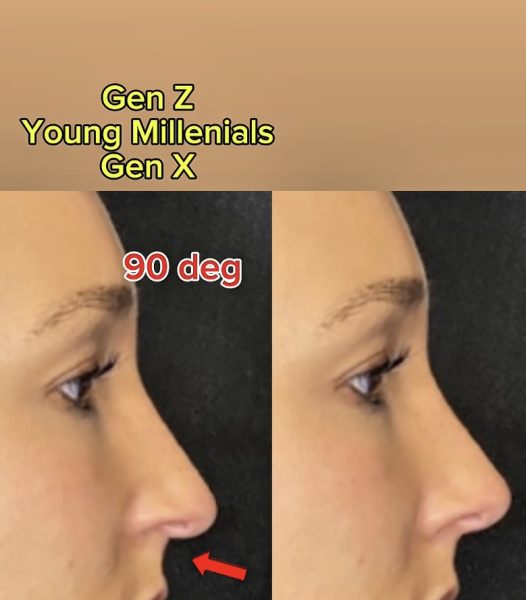
Current Trends in Ideal Nasal Aesthetics
🔹 Past vs Present: Shifting Aesthetic Ideals
Another fascinating insight from the study was that participants without any exposure to rhinoplasty — either personally or through friends/family — tended to favour more conservative nasal angles than those familiar with surgical results.
This may indicate that aesthetic preferences can be shaped not only by generational values and trends but also by exposure to cosmetic treatments and outcomes.
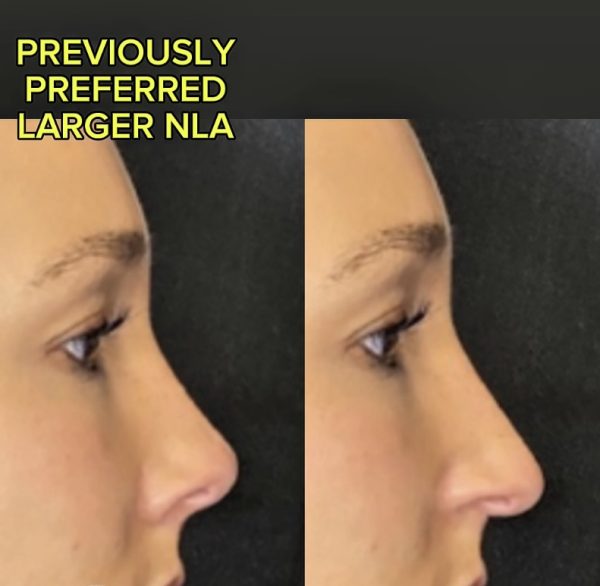
Current Trends in Ideal Nasal Aesthetics
🔹 The Takeaway: Natural Is In
In summary, nasal aesthetic ideals are evolving. We’re seeing a growing preference for:
✅ Higher radix placement
✅ Longer, more balanced noses
✅ Straighter nasal tips with less rotation
While some patients still prefer a slightly upturned nose, the overwhelming trend — especially among younger demographics — is toward subtle, refined changes that maintain facial harmony and avoid an overdone look.
💬 Thinking about rhinoplasty or non-surgical nose reshaping? Please see our gallery for nose results.
Our expert team at The Manse can help guide you toward natural results that align with your personal aesthetic goals — and today’s modern ideals.
📞 Contact us to book a consultation or learn more about your options.